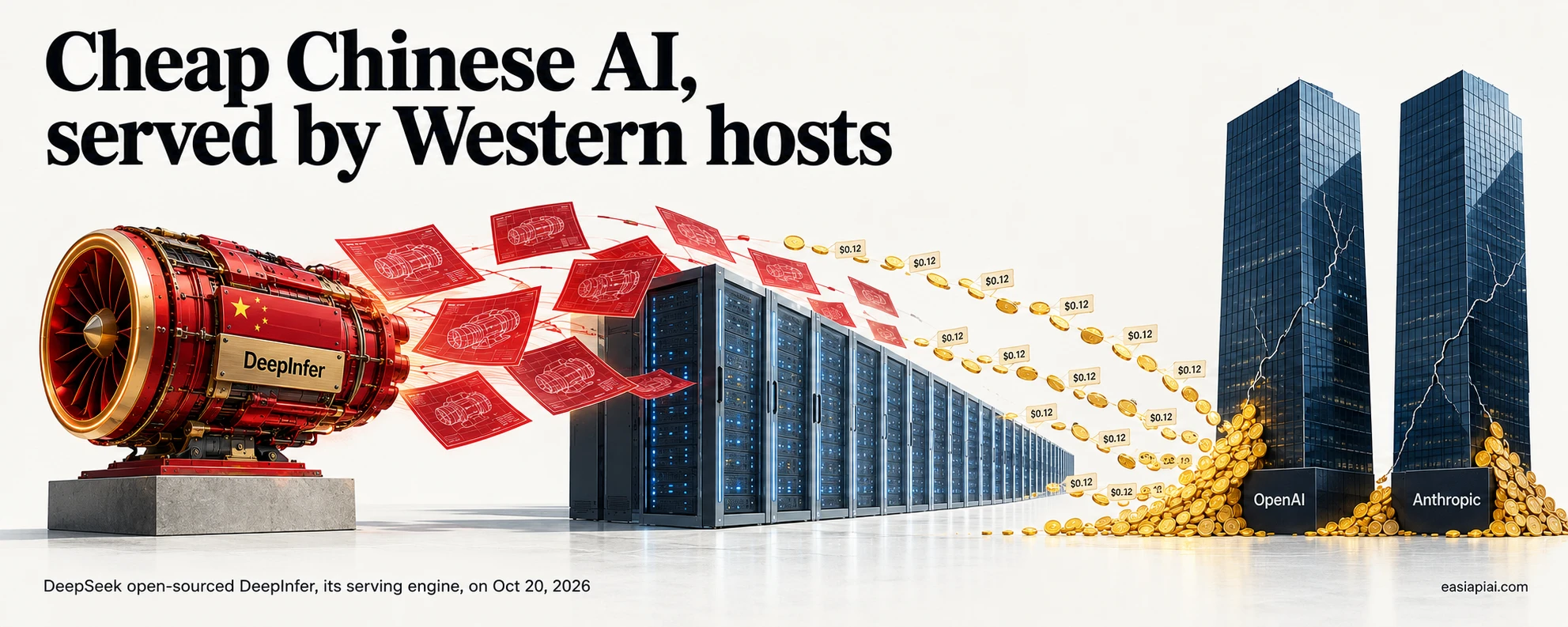
DeepSeek gives away its serving engine
On October 20 DeepSeek open-sourced DeepInfer, the inference framework that runs its production services, under the Apache 2.0 license (GitHub). DeepSeek said it is sharing its production stack "to help the community lower compute costs, reduce energy use, and make AI more affordable" (DeepSeek on X). The repository passed 8,000 GitHub stars within hours (TNW).
An inference engine largely sets what each token costs to serve, and serving tokens is how AI companies earn their revenue. Bloomberg noted that AI companies usually guard these techniques closely, and that cloud and hosting firms running DeepSeek's models could now use the same methods (TNW). Those hosts sell DeepSeek's models against OpenAI and Anthropic, and DeepInfer is built to lower their costs.
The release is partial. It covers offline inference for one model, V4.1-Flash-1017, and leaves out the KV cache system, the split between prompt processing and generation, and the load balancing a full service needs. It runs on Nvidia's SM100 GPUs and, with equal billing, on Huawei's Ascend 950 (The New Stack). Earlier this month DeepSeek also published Huawei chip tools as an alternative to Nvidia's CUDA (TNW).
DeepInfer serves one model, V4.1-Flash-1017, which DeepSeek released three days earlier as a minor update that cuts task time and output length (SiliconANGLE). The API price stays the same and the weights are on Hugging Face under the MIT license. In DeepSeek's own table the model beats Claude Opus 5 on the DeepSWE coding test, 77% to 74%, and loses to Claude on 7 of the 11 benchmarks, by almost 14 points on Humanity's Last Exam.
Together the two releases give anyone a free model and the engine its maker serves it with. DeepSeek tuned the model for agent tools, including Tencent's CodeBuddy and WorkBuddy. The same week it launched search and fetch APIs at 75 cents per 1,000 successful requests, free until November 1 when called from Claude Code or OpenAI's Codex.
Both releases followed a DeepSeek API outage of nearly five hours on October 15, which experts quoted by Bloomberg blamed on a shortage of computing capacity. DeepInfer itself came a day after the US ordered civilian federal agencies to remove DeepSeek products (TNW).
This article argues that DeepInfer is one of the core moves in China's effort to slow the US AI lead, which Chinese labs cannot take at the top. The other tools are open models priced far below US ones and training on the outputs of US models. All of them push down what OpenAI and Anthropic can charge, in the months they need strong revenue to go public, and DeepInfer extends that push to every company that serves DeepSeek's models.
On the current Artificial Analysis index the best open model trails Claude Opus 5.5 by 12 points, after closing to 4 in July. On October 12 Anthropic said its new defenses cut the data distillers harvest from Claude by 90 to 99% (Anthropic). And Beijing's own curbs on chips, talent and capital limit its labs' chips and funding.
The gap closed, then reopened
Chinese open models spent a year closing in on the US leaders, and since the summer the distance has grown again. On the Artificial Analysis Intelligence Index the gap fell to 4 points when Moonshot released Kimi K3 in July, the smallest since February (Artificial Analysis on X, DataNorth). Today Claude Opus 5.5 leads Xiaomi's MiMo-V2.6-Pro, the best open model, by 12 points (Artificial Analysis, TNW).
Part of the jump comes from the index itself. In September Artificial Analysis moved to Terminal-Bench 4.0, added AutomationBench and raised the weight of tests with private tasks from 40% to 45% (Artificial Analysis). Those are the tests closest to paid agentic work, and Kimi K3 shows the effect: it scored 57 on the July index and 44 on the current one, 14 points behind the leader.
Every model at the frontier of AI capability since 2023 has come from the United States, according to Epoch AI. Measured on its composite Epoch Capabilities Index, Chinese models have trailed by seven months on average, with a range of four to 14 months (Epoch AI, January 2026). Almost all leading Chinese models are open-weight, so this is also the gap between open and closed models.
The US government's own testers reached a similar number. In May 2026 NIST's Center for AI Standards and Innovation (CAISI) evaluated DeepSeek V4 Pro, the strongest Chinese model it had tested. It found the model about 8 months behind the frontier and performing "similarly to GPT-5" (NIST). DeepSeek's own numbers had put V4 roughly level with Claude Opus 4.6 and GPT-5.4; on CAISI's private benchmarks the lead of the US models came back.
| Benchmark (CAISI, April 2026) | GPT-5.5 | Claude Opus 4.6 | DeepSeek V4 Pro |
|---|---|---|---|
| ARC-AGI-2, abstract reasoning | 79% | 63% | 46% |
| PortBench, software engineering | 78% | 60% | 44% |
| CTF-Archive-Diamond, cyber | 71% | 46% | 32% |
| SWE-Bench Verified | 81% | 79% | 74% |
| GPQA-Diamond, science | 96% | 91% | 90% |
This is still the latest US government capability evaluation of a Chinese model I could find, and it understates the gap. CAISI compared publicly released models only. Anthropic had given selected partners Claude Mythos Preview on April 7, "a general-purpose, unreleased frontier model" it does not plan to release generally (Anthropic).
Working from compute estimates, The Substrate expects a Chinese lab to build a Mythos-class model around February 2027, with a 90% range of October 2026 to September 2027. That would be a year after Mythos was ready inside Anthropic (The Substrate).
The pattern in the table repeats elsewhere. On public question-and-answer tests the scores are close. On abstract reasoning and long, multi-step work they are far apart.
The distance is largest on agentic work. In April, when the headline gap was 6 points, Artificial Analysis noted that "the gap to proprietary remains wide on the hardest reasoning and agentic coding evaluations": the top open models scored 43–46% on Terminal-Bench Hard against 61% for GPT-5.5 (Artificial Analysis). In September Xiaomi's own launch table put MiMo-V2.6-Pro at 34.9 on Terminal-Bench 4.0, against 49.0 for Claude Opus 5 and 59.6 for GPT-6 Astra (TNW).
The gap has narrowed since 2025 on some measures. The UK AI Security Institute found in July 2026 that GLM-5.2 and DeepSeek V4-Pro match closed models from four to seven months earlier on cyber tasks, down from six to ten months through most of 2025 (The Decoder). Even on that measure Chinese labs are copying a target that keeps moving, and the paid work companies buy AI for is the long, agentic kind where the distance is largest.
The distillation route is closing
Distillation means training a model on another model's answers. A lab that cannot afford the compute to reach the frontier can buy the frontier's outputs instead, as long as the frontier lab keeps selling them.
That route is now largely shut. On October 12 Anthropic said its new defenses cut the data distillers harvest from Claude by around 90 to 99%, and the reasoning tokens they extract by 10 to 100 times (Anthropic). It took eight months of public accusations and countermeasures to get there.
In February 2026 both leading US labs said Chinese labs were doing exactly this. On February 12 OpenAI told the House Select Committee on the CCP that it had seen "accounts associated with DeepSeek employees developing methods to circumvent OpenAI's access restrictions" through "obfuscated third-party routers". It called this an effort "to free-ride on the capabilities developed by OpenAI and other U.S. frontier labs" (Reuters via Yahoo Finance).
Eleven days later Anthropic named three labs (Anthropic). Through about 24,000 fraudulent accounts they ran more than 16 million exchanges with Claude, which Anthropic does not sell in China:
- MiniMax, over 13 million exchanges. When Anthropic released a new model, MiniMax moved nearly half its traffic to it within 24 hours.
- Moonshot AI, over 3.4 million exchanges, later aimed at reconstructing Claude's reasoning.
- DeepSeek, over 150,000 exchanges. It asked Claude to write out its reasoning step by step, used Claude to grade answers, and had it draft censorship-safe replies to political questions.
Anthropic drew the policy conclusion itself. These labs' fast progress, it wrote, could be misread as proof that US chip export controls fail, when it rests heavily on capabilities extracted from American models.
Washington took the same line. In April the White House science adviser Michael Kratsios described "deliberate, industrial-scale campaigns" by entities "principally based in China", and the House Foreign Affairs Committee unanimously advanced a bill to sanction foreign model-extraction (WYPR/NPR). China's embassy answered that it opposes "the unjustified suppression of Chinese companies by the U.S."
Anthropic's September threat report named seven Chinese labs it says routed requests through Claude to harvest its output, Xiaomi among them (TNW). Less than two weeks later Xiaomi released MiMo-V2.6-Pro, now the highest-scoring open-weight model on Artificial Analysis. Xiaomi has not responded to the accusation.
Anthropic's October 12 post describes the defenses behind the 90–99% figure (Anthropic). They include:
- a two-stage classifier with a false-positive rate under 0.1%;
- "preserved thinking", which stops API accounts created on or after August 31, 2026 from editing Claude's earlier context, which makes long reasoning transcripts harder to pull out;
- bans on tens of thousands of accounts, often less than two hours after a campaign starts.
The same post shows what full reasoning is worth to a copier. A model trained on full Claude Opus 4.8 transcripts scored 80.4% on SWE-bench Verified; trained on summarized transcripts, it scored 71.8%. Anthropic says it gave up "meaningful revenue and trillions of tokens' worth of paying traffic from distillers" to get there.
Two limits apply. The 90–99% is Anthropic's own early estimate, and no outside party has checked it. And one lab's wall only helps if the others build one too: Anthropic says Zhipu "distilled the cyber capabilities of leading US models" for GLM-5.3, and that its own work is undermined when attackers can reach "similarly capable models that lack similarly robust anti-distillation safeguards, as Zhipu did".
Beijing closes its own doors
Beijing has added restrictions of its own, aimed at keeping chips, people and money under its control. In January, right after Washington cleared Nvidia's H200 for export to China, Chinese customs told agents the chip was "not permitted to enter China". Officials told tech companies not to buy it unless necessary (Reuters via BusinessDay).
Donald Trump later said Beijing had largely blocked H200 purchases because "they want to develop their own" (ACS Information Age). The domestic option costs capability. Reuters noted that Huawei's Ascend 910C is less efficient than the H200 for large-scale training, and DeepSeek's five-hour outage on October 15 was blamed on a shortage of compute.
DeepInfer fits the same policy. It treats Huawei's Ascend 950 as a main target next to Nvidia's newest GPUs, which makes the domestic chip more usable for anyone serving DeepSeek's models.
People and capital got the same treatment. DeepSeek researchers began handing their passports to the company in March, and in May Bloomberg reported that top AI staff at other private firms, Alibaba included, need approval to travel abroad. In late April Moonshot, StepFun and ByteDance were told to reject US-origin capital in funding rounds unless the National Development and Reform Commission clears it (TNW).
Beijing also demanded that Meta's acquisition of Manus be reversed, and two Manus co-founders were barred from leaving China while regulators reviewed the deal (ACS Information Age). One lever over US hardware remains in reserve. China's ban on exporting gallium, germanium and antimony to the US is suspended only until November 27, 2026, and can be reinstated; gallium and germanium are used in chipmaking (Pillsbury).
So Beijing keeps its own staff, know-how and capital at home, while its labs drew on US models through distillation. The cost falls on those same labs: fewer top chips, and less access to the biggest pool of AI investment while they are losing money.
The cheap-model lever is losing force
For two years Chinese labs have released near-frontier models with open weights and priced their APIs far below US ones. A March 2026 paper for the US-China Economic and Security Review Commission puts it plainly: "China has opted to go all in on an open-source approach to AI", and its labs "charge far less to use high-end products than their global competitors" (USCC, Two Loops). The same paper leaves open whether this is "genuine strategic preference or adaptation to necessity".
The price gap is large. CAISI listed DeepSeek V4 Pro at $1.74 per million input tokens and $3.48 per million output tokens. V4.1-Flash starts at 15 cents per million input tokens off-peak. When the UK AI Security Institute ran a fixed 100-million-token cyber workload, it cost about $85 on Claude Opus 4.6, about $46 on GLM-5.2 and about $1.19 on DeepSeek V4-Pro (The Decoder).
What every seller charges for these models today is tracked on easiapiai.com: DeepSeek V4 Pro, GLM-5.3, Kimi K3, MiMo-V2.6-Pro and Claude Opus 5.5.
On volume, the lever worked. On OpenRouter, Chinese models have carried more than 30% of tokens used by US-billed accounts every week since February 2026, with a peak put at 46% to 58% depending on who counts (Crypto Briefing, Woodford). Three things now blunt it.
Volume is not where the money is. OpenRouter users are developers who switch providers easily, and about half of open-model usage there is roleplay and fiction (Woodford). In the enterprise market Menlo Ventures put Chinese open models at about 1% of LLM API usage at the end of 2025, while Anthropic took 40% of spend and OpenAI 27%. The open-source share of enterprise usage fell from 19% to 11% that year (Menlo Ventures).
The US labs cut prices from the top. By mid-August, the FT reported, OpenAI had cut GPT-5.6 Luna by about 80% and Anthropic had launched Claude Opus 5 at roughly half the price of Fable 5 (BusinessDay). After the cut, Luna's usage on OpenRouter rose 14-fold and its revenue rose 34% (Crypto Briefing). A model that is months behind has to be priced well below the leader's, and the leader's price keeps falling.
The Chinese labs cannot go much lower. Zhipu, maker of GLM, grew first-half revenue about 400% to ¥950 million and still lost ¥2.07 billion. Its average API price rose about 101% since January and its R&D spending is more than eight times its gross profit (36Kr). MiniMax's adjusted net loss doubled to $293 million on $117 million of revenue (MiniMax).
Chinese models still carry a large share of tokens on OpenRouter, and I found no data showing that share falling. What has changed is the cost of holding it: Zhipu is raising prices while the US labs cut theirs.
DeepInfer works around that limit. DeepSeek does not have to cut its own price again to push the market down. It hands the engine it serves with to every host of its models, so any saving it brings can show up in their prices too.
Pressure on the IPO window
Both US leaders are preparing to sell shares. Anthropic confidentially filed a draft S-1 with the SEC on June 1, 2026, and OpenAI followed in early June (24/7 Wall St.). Reuters reported this week that Anthropic is expected to list in mid-November. After its third-quarter results fell short of expectations, some investors argued for a valuation closer to $1.5 trillion, below the $2 trillion targets that had circulated (Reuters via The Manila Times).
OpenAI plans to list in 2027 and is raising about $30 billion at a valuation above $1.4 trillion. One source told Reuters it has about $50 billion in annualized revenue. Anthropic's quarterly revenue rose from $11.6 billion in Q2 to $16.8 billion in Q3, though OpenAI accuses it of booking the gross value of contracts sold through cloud partners.
The Chinese labs earn a small fraction of this, by Rhodium Group's count from summer 2026 (Quartz via Yahoo Finance).
Rhodium partner Logan Wright said "the financing gap means it will be far more difficult for Chinese frontier AI labs to scale sustainably." By Rhodium's estimate DeepSeek is valued at 163 times revenue and Moonshot at 50 times, against 34 times for OpenAI and 21 times for Anthropic.
With revenue in the hundreds of millions, the Chinese startups have no way to outsell the US leaders, so their effect on the IPOs runs through price. Steve Eisman, the investor known from The Big Short, said on his podcast on July 29 that cheap Chinese open-weight models mean a "price war" for OpenAI and Anthropic. He cited Kimi K3 at $3 per million input tokens against $5 for GPT-5.6 Sol and $10 for Claude Fable 5. In August the FT reported both US labs cutting prices, and every cut lowers the revenue an IPO investor can project.
DeepInfer arrived about four weeks before Anthropic's expected listing.
I found no public evidence that Beijing or any Chinese lab times releases to the IPO calendar, and none of the analysts cited here claim it. The case rests on effect. Chinese pricing pushes down what OpenAI and Anthropic can charge in the months their valuations are being set.
The price pressure lands on an industry that pays for its next models with borrowed money. CoreWeave, which rents GPUs to Microsoft and OpenAI according to media reports, carries about $50 billion of debt. On October 15 its April-issued bonds yielded around 15%, and the cost of insuring its debt implied a roughly 63% chance of default within five years, against about 30% a year earlier (Reuters via Investing.com).
The Philadelphia Semiconductor Index fell 11.6% over six sessions. Reuters quoted Gartner's Will Sommer: "our research indicates enterprise and consumer AI revenue will be insufficient to support profitable returns." The CoreWeave coverage does not mention Chinese competition. The link runs through revenue: each price cut a cheaper rival forces lowers the income that services this debt and pays for the next training run, and lenders already doubt that income.
That effect has a limit, and the earlier sections show where it is. The money in this market is paid for long agentic work, where the Chinese models trail by the widest margin. The distillation feed that helped them keep pace is being cut. And Zhipu, one of the labs doing the undercutting, is raising its own prices to cover its losses.
Sources
- GitHub: deepseek-ai/DeepInfer, October 20, 2026
- DeepSeek on X: Introducing DeepInfer, October 20, 2026
- TNW: DeepSeek open-sources DeepInfer, the engine that runs its AI models, October 20, 2026
- The New Stack: DeepSeek open-sources the inference engine behind its API, October 20, 2026
- SiliconANGLE: DeepSeek releases updated V4.1-Flash model, October 18, 2026
- Artificial Analysis: LLM leaderboard, read October 20, 2026
- Artificial Analysis: Intelligence Index v4.3, September 7, 2026
- Artificial Analysis on X: Kimi K3 launch, July 2026
- Artificial Analysis: Recent open weights model launches, April 30, 2026
- DataNorth: Moonshot releases Kimi K3, July 2026
- TNW: A phone maker now has the world's top open-weight AI model, September 22, 2026
- Epoch AI: Chinese AI models have lagged the US frontier by 7 months on average since 2023, January 2, 2026
- NIST CAISI: Evaluation of DeepSeek V4 Pro, May 1, 2026
- Anthropic: Project Glasswing, April 7, 2026
- The Substrate: China will likely have its own Mythos-like model around February 2027, July 3, 2026
- The Decoder: Open-weight models match frontier cyber performance from four months ago, July 2026, on the UK AI Security Institute assessment
- Reuters via Yahoo Finance: OpenAI says DeepSeek trained its AI by distilling US models, February 12, 2026
- Anthropic: Detecting and preventing distillation attacks, February 23, 2026
- WYPR/NPR: Trump administration vows crackdown on Chinese firms exploiting US AI models, April 24, 2026
- Anthropic: Strengthening our defenses against distillation attacks, October 12, 2026
- Reuters via BusinessDay: China blocks Nvidia's H200 AI chips despite US export approval, January 14, 2026
- TNW: China extends AI travel curbs from DeepSeek to other private firms, May 26, 2026
- ACS Information Age: China restricts travel of AI experts amid tech war, May 28, 2026
- Pillsbury: China suspends export controls on certain critical minerals, November 13, 2025
- USCC: Two Loops, How China's Open AI Strategy Reinforces Its Industrial Dominance, March 23, 2026
- Crypto Briefing: OpenRouter developers shift to cheaper AI models, October 13, 2026
- Neil Woodford: Tokens are not money, September 3, 2026
- Menlo Ventures: 2025 State of Generative AI in the Enterprise, December 9, 2025
- BusinessDay: OpenAI, Anthropic enter AI price war, August 14, 2026, citing the FT
- 36Kr: Zhipu AI has not proved its commercial viability, September 1, 2026
- MiniMax: First half 2026 financial results, August 26, 2026
- 24/7 Wall St.: Steve Eisman on cheap Chinese AI models, August 4, 2026
- Quartz via Yahoo Finance: China AI companies earn a fraction of OpenAI, Anthropic revenue, September 17, 2026
- Reuters via Investing.com: CoreWeave shares, bonds slide further as AI debt fears mount, October 15, 2026
- Reuters via The Manila Times: OpenAI raising funds before Anthropic IPO, October 21, 2026